On 25 August we left home just before 5 am to arrive in our hotel in Whitehorse about 30 hours later, at almost midnight local time. A truly exhausting journey!
The next day we picked up our truck camper in which we will spend the coming five weeks.
The plan was to first travel down to Hyder in Southeast Alaska, which we did. However, only when we were driving for about an hour already, we found out that last year's exhausting long trip in this area has really messed up our memories. Ok... let's be fair and say that it was mostly my memory that was messed up. I thought that Hyder could be reached in just about one full day driving, or one day and a short morning at worst. It turned out however that a certain junction (the one where Highway 37 starts from the Alaska Highway) that in my memory was only an hour or so away from Whitehorse was actually well over 400 km away! With all the things we still needed to do in Whitehorse (getting groceries and some other necessities), we only had half a day left to travel and reaching that junction was the best we could do! You can see us sitting there on the campsite near the junction... a lovely place... The concrete was particularly picturesque! Nah, honestly, not the nicest campsite we have ever seen! But oh well, exhausted as we were, we just went to sleep right away and left again at 6.30 am.
Highway 37 is pretty long and pretty lonely though and we wanted to fill up the diesel before setting off. There was a gas station at the junction, but unfortunately it did not open before 7.30 or 8 am (I haven't really kept a close look on clocks since arriving), so we had to wait!
When we started the journey down Highway 37, it felt as if the journey had finally really begun. The word Highway is pretty deceiving for a road that is not even fully paved, has no lines along the first few hundred kilometers and where the road condition did not allow us to go faster than 70 km/h most of the time (40 or 50 km/h along some less developed and unpaved parts).
At a certain point, mum said that what we were doing was like making a 30 hour flight to
 Amsterdam, rent a camper and drive all the way to Southern France doing an average of maybe 60 or 70 km/h! For us Europeans, that would be a ridiculous thing to do, but here we are doing the North American version of it! The good thing about it, is that our journey here lets us go through forests, hills and mountains ALL the time, whereas the journey from Amsterdam to Southern France would be along highways where 130 km/h would be the minimum for some kinds of drivers, through very developed areas with huge cities and only tiny bits of forest in between. Our wildlife score for the 660 km along Highway 37 was -to name just the mammals) - countless red squirrels, one Least Squirrel, one Red Fox (the first we ever saw in North America!!) and five black bears! In the European version of this journey, you might have a chance to see squirrels and some other animals, but the only chance to see bears would be in the extreme south of France, and even then the chance would be almost nill.
This part of the world is really very undeveloped. I think that's good. But I fear for it.. Last year, we travelled along Highway 37 too, and the changes are quite shocking. Rather big parts of it were unpaved then and it was often impossible to exceed 40 km/h! We noticed that there were roadworks going on then, but we never dreamed that these people would work so hard that only a few stretches of unpaved road remain now and it seems like a good guess that next year the whole road will be paved.
Is that bad? This is the only road connecting North and South through Western British Columbia, and what is the harm in getting it paved and making travelling here a bit easier? What harm could this really do to that huge forested area?
Well, first roads through a previously undeveloped area have a huge effect. They form a barrier for many species and an important cause of death by traffic too. Paving that road makes it only worse, because vehicles will be able to travel faster and more vehicles will choose to travel that road too. Huge lorries, which often travel faster than normal cars in North America, are now able to speed along certain stretches of the Highway too, and would never be able to stop in time if wildlife would suddenly step onto the road ahead of them. The direct death toll is very high and only increased because roadsides often offer nice young vegetation which is less concentrated and harder to find away from the road and thus attract many animals too.
But there is more. A first road offers chances for further development. Along one part of the Highway, near Iskut, Royal Dutch Shell (oh, I'm so proud of my country and, incidentally, of this nice corporation that is the main sponsor of the famous Wildlife Photographer of the Year contest, which I haven't participated in since they took over sponsorship from the BBC) is trying to drill for methane, which would very likely poison and ruin to major river systems. The only thing keeping them from it until now is the resistance of local people, many of them Natives. I hope to have a chance to visit some of these people when we will travel back North again.
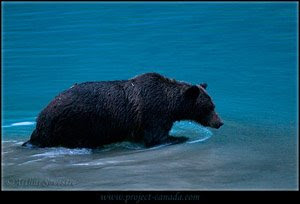
For now, however, we are in Hyder. Yesterday we spent our first day at Fish Creek, which is the
 place we came down here for. This is where grizzly bears fish for salmon and where we hope to get some good images. Moreover, I will try to learn what draws people to this very remote area just to see bears. Why do they really want to see these animals? Is it just to get a nice image, or is there some deeper reason? I will interview a few people during the coming days to find out!
Today, unfortunately, mum is not feeling well, so we could not go to the Creek early in the morning as planned. Too bad on one side, but on the other it gave me time to produce this first update. More will definitely follow, but when is difficult to say. One of the upcoming updates has some very important information about Project Canada, so please keep an eye on the blog and while you're at it, feel very free indeed to forward it to friends, family, colleagues and so on!
Cheers for now!
Arthur